© 2021 Transtelecom Joint-stock Company
2021
Annual Report
Transtelecom JSC
2021 ///
02
The update of the Company
Development Strategy for 2019-2023
was an important event of the year.
Stra
tegic
review
Strategic review
Global trends, competitors, and the Company’s market position were analyzed by the strategic direction. The Company’s Roadmap has been updated based on external factors and internal transformations. On December 29, 2021, the Board of Directors approved a new version of the Company Development Strategy.
Annual Report / Transtelecom / 2021
Description of
the Company
Geography of presence
Transtelecom JSC is one of the largest telecom operators of the Republic of Kazakhstan. The Company has an extensive branch network (14 branches) throughout the Republic.
14
The Company has an extensive branch network (14 branches) throughout the Republic.
Development
Strategy
An important event of the year was the actualization of the Company’s Development Strategy for 2019-2023. The previous Development Strategy was developed by J’son & Partners Consulting in 2018, but it has largely become obsolete.
Strategic Planning and Analysis area analyzed global trends, competitors and the company’s market position. Taking into account external factors and internal transformations in the company, the roadmap was updated. The Board of Directors approved a new version of the Company’s Development Strategy on 29 December 2021.
Additionally, Functional Strategy was revised to be in line with the Company’s updated Development Strategy.
In August 2021, the Company joined the National Association of Communication and Digitalization.
In November 2021, a startup accelerator based on Astana Hub.esa was introduced in collaboration with the largest Plug and Play business accelerator (USA).
7
During the reporting period, 7 new data centers were built, which served to dramatically increase the number of physical servers of the Company.
Vision
The company’s vision is to become a diversified operator of a broad range of ICT services that manages large, complex projects in both the private and public sectors and offers a wide range of services to people and organizations.
The key facts of this statement are:
- Provision of services in all market segments.
- A combination of service provision and project implementation.
- The availability of a sizable service portfolio that combines IT and cloud services with conventional communication services.
Values
Respect – We respect each other.
- The ability to listen and hear others, find common ground and forge mutually beneficial relationships – so long as it does not conflict with the company’s values – while viewing customers, partners, and rivals as equals.
Improvement – We are continually improving.
- The Company is constantly enhancing its operations, the expertise and engagement of its workforce, the effectiveness of its business processes and procedures, and the organizational structure of the company. It also works to improve the quality of its services and their usability for customers.
Reliability and reputation – We are a reliable company, we value our reputation.
- The Company makes efforts to preserve and increase the reputation of a reliable service provider and partner, a socially responsible and law-abiding market player.
Mission
To lead Kazakhstanis to digital prosperity, drawing on the company’s unique capabilities:






Overview of the
telecommunications
market in 2021
Telecommunications services
market of the Republic of
Kazakhstan
Kazakhstan is one of the most developed telecommunications sectors in the Central Asian region, particularly in the mobile communication segment, where wide network coverage ensures a very high level of penetration.
Telecommunications companies have been successful in improving their margins and revenues by expanding value-added services and leveraging the capabilities of their high-speed 4G LTE networks and fiber optics to significantly increase data usage.
Kazakhstan’s telecoms market, excluding fixed-line services, is expected to return to moderate growth from 2022. The extensive deployment of LTE networks across the nation (along with the potential addition of 5G services in 2023) points in particular to an even greater proliferation of profitable mobile broad-band services.
Key market events:
- Kazakhstan’s mobile market has reached saturation point. Slow growth is projected until 2024.
- New OneWeb satellites have been launched in Kazakhstan.
- The Government joins the ITU-sponsored GIGA initiative.
- Fixed-line telephone penetration continues to decline as the mobile segment continues to expand.
- 5G services are planned to be launched in the near future.
- Mobile broadband access is actively developing due to the mature mobile market.
- Knell has launched a pilot IoT service for agriculture using its 3G, 4G LTE and NB-IoT networks.
- ALTEL mobile operator starts testing 5G in Almaty and Turkestan, using a test spectrum in the range of 3500 MHz, but the government reduces expectations regarding the appearance of commercial services until 2023.
- The regulator introduces new minimum data transfer rates for 3G (1 Mbit/s) and 4G (5 Mbit/s) services.
- Jysan Bank launches the second MVNO in Kazakhstan, Jysan Mobile, operating in the ALTEL network.
- Beeline mobile operator launches GPON FttP service in Nur-Sultan with a speed of up to 500 Mbit/s.
- Unit Telecom Company acquires 75% of the shares of Transtelecom JSC, completing the privatization program of the latter.
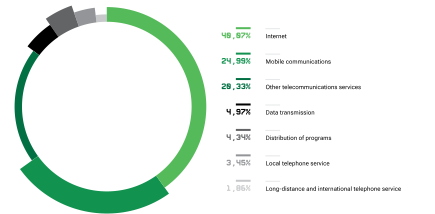
revenue structure from
communication services
in Kazakhstan for 2021
Source: Statistics Committee of the MNE of the RoK
The Republic of Kazakhstan’s Bureau of National Statistics estimates that in 2021, the volume of the country’s market for communication services was 1,012.1 billion tenge, a 14.4% increase over the previous year. The volume of Internet services amounted to 405.5 billion tenge (+22.2%), the volume of cellular services – 252.9 billion tenge (+9.3%). The volume of local telephone services, on the contrary, decreased and amounted to 34.9 billion tenge, which is 2.6% less than in 2020.
The amount of long-distance and international telephone services offered is also declining annually. As a result, in terms of comparable prices, their volume in 2021 was 18.7 billion tenge, which is 12.2% less than their volume in 2020.
The income of Transtelecom JSC from the above services in 2021 amounted to 30.07 billion tenge, which amounted to 2.95% of the total market volume according to the Bureau of National Statistics of the Republic of Kazakhstan.
| Services | 30,071,964 |
| Data transmission and satellite communication services | 4,865,483 |
| Long-distance/international communication services | 489,795 |
| Local telephone services | 870,934 |
| FOCL backbone network rental services | 9,867,114 |
| Internet access services | 9,805,681 |
| International transit services | 4,172,940 |
Note: the table above includes only income from services corresponding to those provided by the Bureau of National Statistics. Income from other services and projects of Transtelecom JSC is not included.
The share of TTS in the market of
communication services by services
| Internet | 4,85% |
| Data transmission | 17,969% |
| Local telephone service | 2,49% |
| Long-distance and international telephone communications | 2,61% |
Note 1: In the market volume data from the MNE RoK, revenues from backbone FOCL leasing services are included in revenues from Internet access services. For the sake of comparability, revenues from lease of Transtelecom’s backbone FOCLs are also included in revenues from Internet access services.
Note 2: In the market volume data from the MNE RoK , international transit revenues are included in data access service revenues. For the correctness of the comparison, the income from the international transit of Transtelecom JSC is also included in the income from data transmission services.
Business
review and
assessment
business model
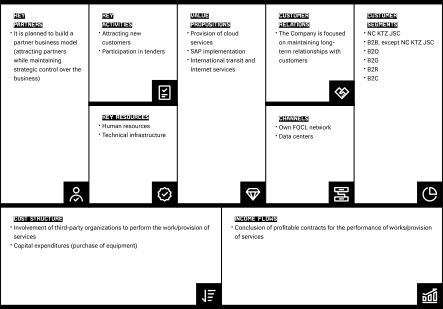
TTC uses a predominantly project-based business model, involving the implementation of large projects for corporate clients and public sector. The Company’s Development Strategy for 2019-2023 assumes a transition to a mixed project-product business model. The advantage of using such a business model is to reduce the company’s dependence on one-time project-related revenues by increasing the share of regular revenues generated by the sale of standard products. The transition to a project-product model also contributes to the implementation of the strategic goal of expanding the Company’s customer base.
Below is a description of the
current TTC business model in
the Business Model Canvas format.
Assessment ofthe Company’s
position and prospects
for its development
The Company is an active market player with a significant share of the IT technology market. The company’s positive reputation and strategic positioning have been made possible by a proactive approach to working with business clients and a high degree of customer focus. The Company’s competitive position in the cloud services market has been ensured by experience in executing large IT projects and building a cloud infrastructure for their implementation.
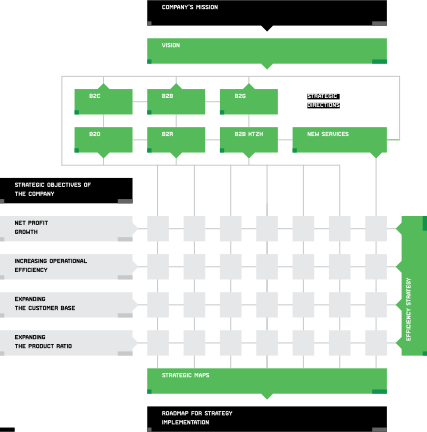
As part of the Development Strategy for the period up to 2023, the Company will focus on four key strategic areas:
- B2C segment where the Company will increase and continue its expansion in this market through pre-sales on a combined subscriber base of double and triple-play services, as well as offering subscribers a new package of services – cloud services and non-ICT partner services sold through the marketplace;
- B2B/B2G segment where the Company will seek to transform its business model towards offering a wide range of services to a wide range of customers in the format of packages formed according to industry and customer size;
- B2O market, where the company will concentrate on creating a value proposition of services, it will be able to stand out from competitors and maintain prices for the services provided in the face of ongoing price competition in the market;
- new solution segment where the company will increase the variety of cloud services provided for other strategic areas, such as increasing the variety of XaaS services provided toward the provision of integrated services and packages of them, as well as offering SaaS services and software on a large-scale on a subscription basis. It will also be building up its competences in new markets such as information security, the Internet of Things, big data and the digitalization of business.
Functional
Strategies of
the Company
In 2021, the Company continued to implement the Functional Strategies of the B2B, B2G, B2O, B2C, B2R and railway business development blocks.
Within these strategic areas, Transtelecom JSC has the following strategic objectives:
- Growth of the company’s net profit.
- Increase in operational efficiency.
- Expansion of the customer base in all segments, decrease in the share of revenue provided by NC KTZ JSC, increase in the share of service revenue.
- Expansion of the company’s product portfolio.
Below is
the Company’s
strategic matrix: