© 2021 Transtelecom Joint-stock Company
2021
Annual Report
Transtelecom JSC
2021 ///
05
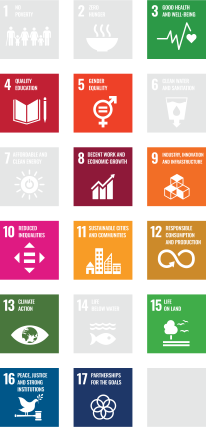
Transtelecom JSC is committed to 17 SDGs
by incorporating sustainable development
principles into its operations.
Sustai
nable
develop
ment
Sustainable development
Transtelecom JSC’s activities in sustainable development are founded on the responsible business principle and innovative capacity, creating new opportunities for economic growth, and environmental and social well-being.
Annual Report / Transtelecom / 2021
Sustainable
development
goals
Transtelecom JSC is committed to 17 Sustainable Development Goals by integrating the principles of sustainable development into its operations. Transtelecom JSC is aware that the environmental and social problems that each of the SDGs reflects are relevant and have an impact on any organization.
The sustainable development initiatives of Transtelecom JSC are founded on the idea of ethical business practices and innovative potential, creating new chances for economic growth and environmental and social well-being.
The Company focuses on improving the quality of life of the population in the places of presence, improving the quality of its services by means of innova-tive technologies, social and educational programs, transparency of activities, reducing the negative impact on environmental issues.
The Company has
undertaken to implement
the following principles:
- in the field of human rights: to support and respect the observance of human rights proclaimed by the international community, to ensure their non-involvement in human rights violations;
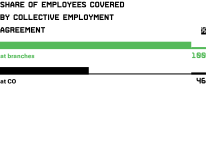
- in the field of labor relations: to support freedom of association and practical recognition of the right to collective agreement, advocate the abolition of all forms of forced labor and the total eradication of child labor, as well as the elimination of discrimination in employment and occupation;
- in the field of environmental protection: to contribute to the prevention of adverse impacts on the environment; to take initiatives aimed at increasing responsibility for the state of the environment; to promote the development and dissemination of environmentally friendly technologies;
- in the field of anti-corruption: to resist all forms of corruption, including ex-tortion and bribery.
Interaction with
Stakeholders
Implementing the principle of active dialogue with stakeholders, Transtelecom JSC strives to ensure the highest level of openness and transparen-cy of its activities. The Company maintains active communications with all its stakeholders, providing timely and relevant information on all aspects of its activ-ities and responding to stakeholder requests and wishes.
3,350
Transtelecom provides jobs for more than 3,350 people.
Stakeholders
map
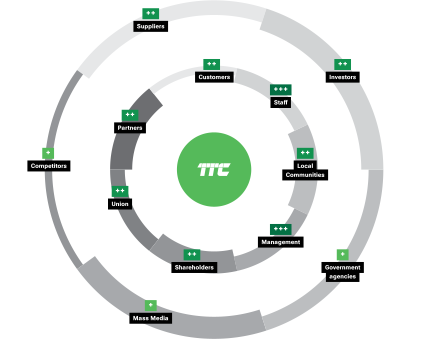
On the stakeholder map, three concentric areas of the Company’s influence on a particular stakeholder are distinguished:
+ + + Area of authority/responsibility
The stakeholders directly subordinate to the Company have been identified in this area.
+ + Area of direct influence
There are stakeholders in this area who are directly influenced by the Company.
+ Area of indirect influence
This area includes stakeholders who are indirectly influenced by the Company..
The approach to interaction is based
on the following principles:
- regular constructive dialogue;
- partnership;
- mutually beneficial cooperation;
- trust and sincerity;
- publicity and transparency;
- fulfillment of the obligations assumed.
The key stakeholders of the Company are shareholders, trade unions, consumers, suppliers, employees, government agencies, media and local communities.
Personnel
Transtelecom JSC has an approved HR strategy for the period 2021-2023 dated 30.12.2020. The company’s mission and vision are to become a diversified operator of a wide range of infocommunication services by 2023, executing large, complex projects in the private and public sectors, and offering a wide range of services to people and organizations. The HR strategy outlines the primary directions of personnel development required for putting these goals into practice.
Development
of a corporate
university
The Corporate University «TTC GREEn University» (hereinafter referred to as «CU») is an internal training system that covers all levels of employees, from managers to specialists, and is established to train and develop personnel in accordance with the mission and strategic goals of the Company.
The main priorities of the CU include: creation of a learning infrastructure for accumulation, preservation and transfer of knowledge and skills in the Company; development of coaching institute and maximum disclosure of talents; creation of a comprehensive training system for managerial, hard and soft skills. This area includes the development of a distance learning system, the Train the Trainer system and the development of comprehensive programs.
Employee
Retention
Strategy
The Company’s Employee Retention Strategy aims to keep employees engaged in the job despite sporadic organizational challenges and potential lucrative job offers. The success of the company greatly depends on the employee’s continued motivation and positive attitude. Implementing a retention program is a good way to make sure that employees are employed and that there is a healthy work-life balance to boost productivity. The following tasks are being completed as part of the implementation of the key Employee Retention Strategy: the creation of a talent pool, a variable compensation system, and employee loyalty programs.
Development
of competence
centers
According to the Company’s Development Strategy, one of the crucial elements in ensuring the Company’s successful movement is the transition to a mixed business model, where the Company’s current project business model is complemented by a product business model focused on the mass client, both private and business ones.
In this regard, it is essential to establish competence centers in the areas of product development, data centers, and architecture.
Expected results from the implementation of the HR Strategy:
- Building a strategically oriented HR Strategy model that develops and enhances the quality of the Company’s human capital.
- Corporate University with a developed training infrastructure and a coaching community as a catalyst for knowledge, skills, and competencies for personnel.
- Formed system of cumulative remuneration that affects the final results of the business.
- Developed competence centers in the field of priority areas: product development, data centers, architecture.
Safety
at work
Health protection
Prevention of health hazards, accidents and injuries is a key element of our company’s sustainable strategy and an integral part of our business processes. Occupational safety and successful management of technical risks play an important role in protecting our employees and assets, thereby contributing to the Company’s competitiveness. The absolute priorities of Transtelecom JSC in the field of occupational health and safety are to ensure trouble-free operation of production facilities, as well as to increase the level of safety of the Company’s employees, reduce occupational injuries and occupational diseases.
In 2021, no cases of occupational injuries were registered in the Company, as in 2020.
In accordance with the legislation of the Republic of Kazakhstan, the Company has established and successfully operates Occupational Health and Safety Services (both in Central Office and in each regional branch). The main functions performed by employees of the Occupational Health and Safety Services:
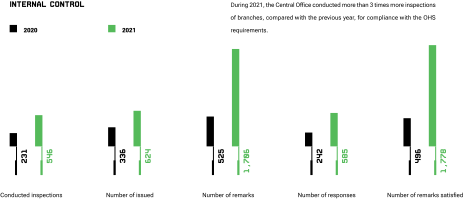
- internal control of occupational health and safety;
- identification of risks and hazards;
- training of personnel in industrial safety and occupational health.
Execution of the
comprehensive plan of
Transtelecom JSC
for 2021
Complex plan
- 195 events
- 190 thousand tenge
Execution
100%

Personnel composition
Personnel structure by gender and age groups
| Personnel category | Total | of these: | |||||
|---|---|---|---|---|---|---|---|
| men | women | ||||||
| persons | % | persons | % | persons | % | ||
| Staff Strength | 3728 | 100 | 2262 | 60.7 | 1466 | 39.3 | |
| Managers | 419 | 11.2 | 309 | 73.7 | 110 | 26.3 | |
| Specialists/Office workers | 2634 | 70.7 | 1752 | 66.5 | 882 | 33.5 | |
| Production workers | 675 | 18.1 | 201 | 29.8 | 474 | 70.2 | |
| Personnel category | Total | of these: | ||||||||||
|---|---|---|---|---|---|---|---|---|---|---|---|---|
| under 25 | 25-34 years old | 35-44 years old | 45-54 years old | age 55 and older | ||||||||
| persons | % | persons | % | persons | % | persons | % | persons | % | persons | % | |
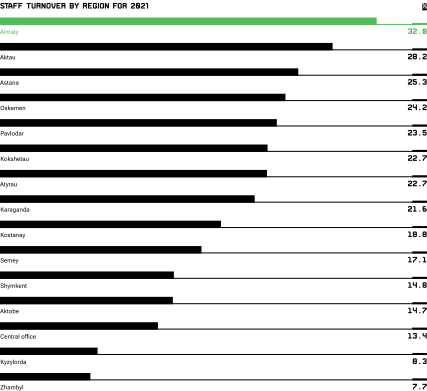
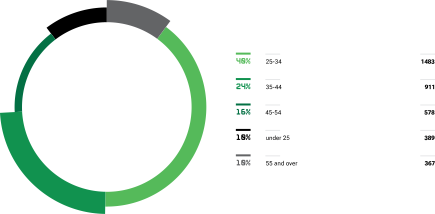
| Staff Strength | 3728 | 100 | 389 | 10.4 | 1483 | 39.8 | 911 | 24.4 | 578 | 15.5 | 367 | 9.8 |
| Managers | 419 | 11.2 | 3 | 0.7 | 149 | 35.6 | 151 | 36.0 | 83 | 19.8 | 33 | 7.9 |
| Specialists/Office workers | 2634 | 70.7 | 358 | 13.6 | 1194 | 45.3 | 611 | 23.2 | 301 | 11.4 | 170 | 6.5 |
| Production workers | 675 | 18.1 | 28 | 4.1 | 140 | 20.7 | 149 | 22.1 | 194 | 28.7 | 164 | 24.3 |


Number of hired employees by gender and age groups
| Personnel category | Total | of these: | |||||
|---|---|---|---|---|---|---|---|
| men | women | ||||||
| persons | % | persons | % | persons | % | ||
| Staff Strength | 1015 | 27.2 | 727 | 71.6 | 288 | 28.4 | |
| Managers | 45 | 10,7 | 32 | 71,1 | 13 | 28,9 | |
| Specialists/Office work-ers | 825 | 31.3 | 614 | 74.4 | 211 | 25.6 | |
| Production workers | 145 | 21.5 | 81 | 55.9 | 64 | 44.1 | |
| Personnel category | Total | of these: | ||||||||||
|---|---|---|---|---|---|---|---|---|---|---|---|---|
| under 25 | 25-34 years old | 35-44 years old | 45-54 years old | age 55 and older | ||||||||
| persons | % | persons | % | persons | % | persons | % | persons | % | persons | % | |
| Staff Strength | 1015 | 100 | 217 | 21.4 | 445 | 43.8 | 272 | 26.8 | 59 | 5.8 | 22 | 1015 |
| Managers | 45 | 4.4 | 0.0 | 12 | 26.7 | 26 | 57.8 | 6 | 13.3 | 1 | 45 | |
| Specialists/Office workers | 825 | 81.3 | 199 | 24.1 | 379 | 45.9 | 206 | 25.0 | 31 | 3.8 | 10 | 825 |
| Production work-ers | 145 | 14.3 | 18 | 12.4 | 54 | 37.2 | 40 | 27.6 | 22 | 15.2 | 11 | 145 |
Headcount by
age in 2021
Performance evaluation
| Personnel category | Staff Strength | of these: | of these, those who have passed the performance evaluation: | ||||
|---|---|---|---|---|---|---|---|
| men | women | men | women | ||||
| persons | persons | persons | % | persons | % | ||
| Staff Strength | 3728 | 2262 | 1466 | 38 | 1.7 | 2 | 0.1 |
| Managers | 419 | 309 | 110 | 38 | 12.3 | 2 | 1.8 |
| Specialists/Office workers | 2634 | 1752 | 882 | – | 0.0 | – | 0.0 |
| Production workers | 675 | 201 | 474 | – | 0.0 | – | 0.0 |
The ratio of women’s remuneration to men’s remuneration in 2021
| Personnel category | Base rate, % | of these: | Award, % | of these: | ||
|---|---|---|---|---|---|---|
| men, % | women, % | men, % | women, % | |||
| Managers | 25.7 | 72.6 | 25.7 | 100.0 | 100.0 | 0 |
| Specialists/Office workers | 66.0 | 81.9 | 66.0 | – | – | – |
| Production workers | 8.3 | 72.4 | 8.3 | – | – | – |
Personnel training
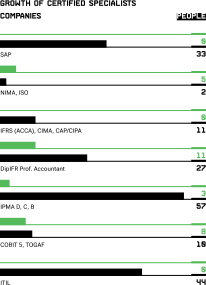
The expertise and professionalism of employees directly affects sustainable development and achieving market leadership. In order to improve the professionalism of employees and the competitiveness of the Company, special attention is paid to the certification of the Company’s specialists. 40 professionals received their certifications in 2021, including those in the fields of project management, economics, finance, and marketing as well as information technology infrastructure, network hardware, routing, and virtualization. The total number of certified specialists of the Company increased by 0.6%.
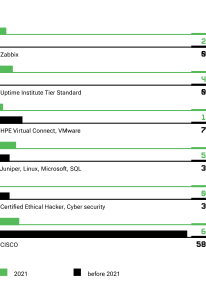
Average hours of training completed in the reporting year, per employee of the company (men, women)
| total number of hours | number of people | average number of hours per 1 person |
|---|---|---|
| Total | ||
| 64333 | 3500 | 18.38 |
| men | ||
| 43651 | 2262 | 19.3 |
| women | ||
| 20682 | 1238 | 16.7 |

Corporate TTC
GREEn University
In 2021, the 3rd batch of internal trainers was graduated from TTC GREEn University. Our internal trainers of the 3rd batch have successfully completed the 6-module program «Train a trainer».
90%
satisfaction with internal learning
69%
% coverof branches
1,015
covered trained staff
11
internal training courses
25
internal coaches
3
productive training courses
2
workshops
Social
policy
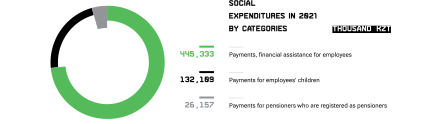
As a motivational tool, Transtelecom JSC’s social policy has a direct impact on an individual’s level of satisfaction, which in turn has an impact on the company’s activities’ production and economic indicators. It aims to raise staff satisfaction indicators, enhance employee quality of life, and help those who require social assistance (such as workers, pensioners, WWII veterans, and people who are equivalent to them).
Voluntary
health insurance
The voluntary insurance services are used annually by employees of the company for medical emergencies. In 2021, the Company signed an agreement with IC «Halyk» JSC. During the year, 6,105 people used insurance services, of which 2,777 employees and 3,328 family members. The amount of the insurance premi-um amounted to 332,768 thousand tenge.
Interaction with
universities of the
Republic of Kazakhstan.
Internship Transtelecom JSC.
the internship took place in ttc JV:
- Architecture and Design
- It development and implementation of IT TUMC, ACC, ABP, in the B2C sectors, B2O, MS, SIT, LKB, TUMC, DATS, etc.
for 2021:
- Suleiman Demirel University, Astana IT University, Turan-Astana and regions
20
signed memoranda, including for 2021 – 7
176
students have completed an internship
28
are employed in co and regions
A concerted effort is being made to engage with educational institutions in the Republic of Kazakhstan in order to interact with young people who have promise and talent and draw them to the company. Currently, the Company cooperates with more than 20 educational institutions in all major cities of Kazakhstan, including regional centers.
In total, the Company has signed more than 20 Memorandums of Cooperation with universities of the Republic of Kazakhstan, 7 of them were concluded in 2021 (3 of republican significance, 4 regional universities). At the same time, Transtelecom expanded the list of its partner universities with the Suleiman Demirel University, Astana IT University LLP, Turan-Astana University Institution.
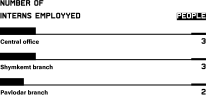
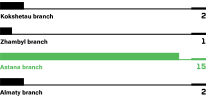
In 2021, 176 students had internships in the company’s structural subdivisions, 28 of them were employed. 15 students are employed in the branch of Astanatranstelecom.
The purpose of the internship is the formation of students’ skills and practical skills in professional activity.
In the outgoing year, Transtelecom JSC participated in 5 job fairs of the following universities: Nazarbayev University, S. Toraigyrov Kazakh Agrotechnical University, S.Seifullin Kazakh Agrotechnical University, Astana IT University (career weeks); University of Central Asia (mock interviews/Computer Science); KIMEP (Job Fair). These meetings offer a special chance for recent graduates and students to learn more about the company’s operations, become familiar with Transtelecom JSC’s mission and vision, sit for an interview with an HR manager, discover the requirements for open positions, and complete an internship or apprenticeship with the Company.
In order to train new technical personnel, the Company is working on the development of dual training – attracting young specialists (students) for further employment in Transtelecom JSC.
Transtelecom JSC branch in Atyrau, Atyrautranstelecom, signed an agreement with Safi Utebayev Atyrau Oil and Gas University, NJSC.
Dual education provides an opportunity for promising and talented young people to experience their future profession by learning its specifics in practice. TTC actively works with educational institutions in all major cities of Kazakhstan, including regional centers.
TTC cooperates with more than 20 educational institutions and is expanding the dual education program.
Dual education gives promising young people the opportunity to immerse them-selves in their future profession by learning the ins and outs of it in practice. For example, the Atyrautranstelecom branch and the Safi Utebayev Atyrau Oil and Gas University signed an agreement on cooperation in higher (bachelor) education to introduce a dual system of personnel training. In accordance with this agreement, the branch intends to hire up to 20 IT students annually after conducting a competitive hiring process. A similar agreement, designed already for undergraduates, is also valid with S. Seifullin Kazakh Agrotechnical University in the specialty «Information security».
Environmental
Protection
Environmental
initiatives and approach
to environmental protection
The Company’s environmental protection activities are carried out in accordance with the Environmental Code of the Republic of Kazakhstan and other regulatory legal acts in the field of environmental protection.
The Company does not cause direct significant harm to the environment by its activities and does not conduct business in potentially environmentally hazardous industries. However, we recognize that improving energy efficiency of operations, conserving resources, and reducing adverse environmental effects are urgent tasks for the Company as a major player in the telecommunications and IT technologies market operating throughout Kazakhstan.
WIn 2021, the Company passed a compliance audit for compliance with the requirements of the ISO 14001 standard in the field of environmental protection.
In 2021, EIA projects were drafted as part of Transtelecom’s Infrastructure Development projects to provide data center infrastructure as a service:
- Construction of outdoor off-site engineering networks for office buildings with a data processing center».
- The draft of the MPE standards developed at the Company’s branches.
- Environmental emission permits, air pollution emission caps, and environmental emission fee declarations for 2021.
In connection with the new Environmental Code of the Republic of Kazakhstan, which went into effect on 2 January 2021, the Company’s branches applied to the appropriate environmental protection authorities for a classification of the relevant facilities into categories I, II, III, and IV. Category IV of the facility was determined within the project «Development of infrastructure of Transtelecom JSC for providing data center infrastructure as a service,» according to the decisions made by the authorized environmental authority for classifying the facilities that have an adverse impact on the environment.
There were no comments from prescriptive regulatory authorities for the period 2020-2021.
In 2021, there are no penalties and other non-financial sanctions imposed for non-compliance with environmental legislation.
Use of energy
resources and energy
conservation
The Company prefers to introduce resource-saving and environmentally friendly technologies when replacing outdated ones with new ones. The Company conducted an energy analysis. Electricity, heat, and fuel are the three areas with the highest energy consumption, according to the analysis of the use and consumption of energy resources for the baseline period 2022–2021. These energies also offer the potential to improve energy performance.
The main energy efficiency indicators (energy efficiency indicator) are as follows: electricity consumption for FOCL and HSN equipment, thermal energy consumption, gasoline consumption by motor vehicles for FOCL and TTS and auxiliaries maintenance, diesel fuel consumption by motor vehicles for FOCL and TTC and auxiliaries maintenance.
The actual consumption of fuel and energy resources by Transtelecom JSC for 2021
| Electricity | Heat power | Gasoline | Diesel | |
|---|---|---|---|---|
| Actual power consumption (kWh) | Actual consumption of thermal energy (Gcal) | Fuel costs for motor vehicles (passenger, cargo, and industrial) (l) | Fuel costs for motor vehicles (passenger, cargo, and industrial) (l) | |
| FOCL | 5972821.41 | 569.4779 | 414480.728 | 88998.59 |
| TTS and auxiliaries | 8952315.53 | 3881.6207 | 388257.587 | 25552.36 |
| 14925136.94 | 4451.0986 | 802738.315 | 114550.95 | |
Energy efficiency indicators of Transtelecom JSC for 2021
| Indicators | 01. 2021 |
02. 2021 |
03. 2021 |
04. 2021 |
05. 2021 |
06. 2021 |
07. 2021 |
08. 2021 |
09. 2021 |
10. 2021 |
11. 2021 |
12. 2021 |
Average |
|---|---|---|---|---|---|---|---|---|---|---|---|---|---|
| W FOCL | 40.15 | 39.65 | 36.53 | 36.05 | 36.51 | 39.21 | 38.6 | 40.75 | 37.66 | 33.67 | 35.13 | 36.68 | 37.55 |
| W TTS and auxiliaries | 28.19 | 24.58 | 22.6 | 21.83 | 24.83 | 27.68 | 28.06 | 26.75 | 26.49 | 27.51 | 28.7 | 25.02 | 26.02 |
| Q h. e. | 0.04 | 0.04 | 0.03 | 0.02 | 0 | 0 | 0 | 0 | 0 | 0.02 | 0,03 | 0,03 | 0.02 |
| V gaso-line | 4.96 | 5.6 | 4.68 | 4.98 | 5.15 | 5.68 | 4.86 | 4.76 | 5.22 | 4.89 | 5.59 | 5.39 | 5.15 |
| V diesel | 0.67 | 0.38 | 0.84 | 0.91 | 0.78 | 0.76 | 0.76 | 0.76 | 0.76 | 0.86 | 0.61 | 0.56 | 0.72 |
Energy
efficiency monitoring
for 2020-2021
| Types of fuel and energy resources | UOM | 2019 | 2020 | 2021 | difference (+/-) 2020/2021 | deviations (%) 2020/2021 |
|---|---|---|---|---|---|---|
| Electricity | kWh | 12 570 220 | 12 729 196 | 14 925 137 | 2 195 941 | 17.25 |
| Heat power | Gcal | 4 428 | 4 360 | 4 451 | 91 | 2.08 |
| Diesel fuel | ton | 130,523 | 106,081 | 114,551 | 8470 | 7.98 |
| Gasoline | ton | 852,520 | 860,617 | 802,738 | -57 879 | -7.21 |
The potential for energy efficiency improvement over the next three years is no more than 3% of baseline energy consumption.
In the future, electricity consumption will increase due to the implementation of new projects, ownership, and commissioning of new properties.
Air emissions
and climate
change
The telecommunications sector has a relatively insignificant impact on the environment compared to other industries. However, due to the increasing importance of global and local environmental problems, Transtelecom JSC aims to implement measures to compensate for damage from its activities by minimizing direct and indirect environmental impacts.
To manage the environmental aspect, the company has established an environmental management system (EMS), which is an integral part of the corporate governance system and an essential part of the non-financial risk management system. The Company is certified for compliance with the international standard ISO 14001 and is working on continuous improvement of EMS.
All of the Company’s enterprises obtain permits as part of their production activities, and they all yearly submit statistical data to the regulatory authorities.
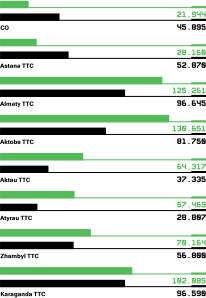
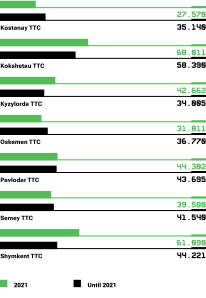
The total amount of emissions into the atmosphere in 2021 amounted to 914,997 tons.
Emissions of gaseous pollutants by branches for 2021
| No. | Branches | Actual volume, ton | Amount for emission to the environment, tenge | |
|---|---|---|---|---|
| 1 | CO | 21.944 | 255,472.19 | -52% |
| 2 | Astana TTC | 28.16 | 60 114 | -47% |
| 3 | Almaty TTC | 125.261 | 301,171.5 | 30% |
| 4 | Aktobe TTС | 130.651 | 346,411.69 | 60% |
| 5 | Aktau TTC | 64.317 | 179,870 | 72% |
| 6 | Atyrau TTC | 57.469 | 405,489.59 | 99% |
| 7 | Zhambyl TTC | 70.164 | 166,832 | 24% |
| 8 | Karaganda TTC | 102.085 | 296,217 | 6% |
| 9 | Kostanay TTC | 27.57 | 56 068,83 | -22% |
| 10 | Kokshetau TTC | 68.011 | 140,003 | 16% |
| 11 | Kyzylorda TTC | 42.662 | 151,251.59 | 25% |
| 12 | Oskemen TTC | 31.811 | 61 790 | -13% |
| 13 | Pavlodar TTC | 44.302 | 86 752 | 1% |
| 14 | Semey TTC | 39.5 | 76 537 | -5% |
| 15 | Shymkent TTC | 61.09 | 121,488.95 | 38% |
| Total | 914.997 | 2 705 469,34 | ||
| No. | Name of the Substance | Tons/year |
|---|---|---|
| 1 | Sulfur dioxide | 0.87 |
| 2 | White spirit | 0.36 |
| 3 | Carbon | 0.33 |
| 4 | Inorganic dust containing silicon dioxide in %: less than 20 (dolomite, G680 cement production dust – limestone, chalk, cinders, raw mix, rotary kiln dust, bauxite) | 0,01 |
| 5 | Inorganic dust containing silicon dioxide in %: 70-20 (fire clay, cement, cement production dust – clay, clay-slate, blast furnace slag, sand, clinker, ash, silica, coal ash of Kazakhstan deposits) | 8.13 |
| 6 | Lead and its inorganic compounds (expressed as Pb) | 0 |
| 7 | Fluoride gaseous compounds (expressed as fluorine) | 0 |
| 8 | Ethanoic acid | 0 |
| 9 | Ethanol | 0.05 |
| 10 | Carbon oxide | 5.53 |
| 11 | Formaldehyde | 0.07 |
| 12 | Inorganic fluorides poorly soluble – (aluminum fluoride, calcium fluoride, sodium hexafluoroaluminate) | 0 |
| 13 | Wood dust | 0.31 |
| 14 | Benzopyrene | 0.29 |
| 15 | Butanol | 0.03 |
| 16 | Butyl acetate | 0.06 |
| 17 | Nitrogen (II) oxide | 2.01 |
| 18 | Nitrogen (IV) dioxide | 3.14 |
| 19 | Alkanes C12-19 (expressed as C) | 1.88 |
| 20 | Manganese and its compounds (expressed as manganese (IV) oxide/ (327) | 0 |
| 21 | Methylbenzene | 0.03 |
| 22 | Tin oxide (expressed as tin) | 0 |
| 23 | Suspended substances | 0 |
| 24 | Iron (II, III) oxides | 0.28 |
| 25 | Xylene (mixture of o-, m-, p-isomers) | 0.08 |
| 26 | Gasoline (petroleum, low-sulfur) (expressed as carbon) | 0 |
| 27 | Propanone | 0.12 |
| 28 | 2-Ethoxyethanol | 0.01 |
| 29 | Disurma trioxide (expressed as antimony) | 0 |
| 30 | Dimethylbenzene (mixture of o -, m -, p-isomers) | 0.18 |
| 31 | Chloroethylene | 0 |
| 32 | Suspended particles PM10 (1) | 0 |
| 33 | Hydrogen sulfide (dihydrosulfide) | 0.44 |
| 34 | Oxyran | 0 |
| 35 | Abrasive dust | 0 |
| 36 | Chloroethylene | 0 |
| 37 | Prop-2-en-1-al (acrolein) | 0.07 |
| Total | 24.3 | |
The Company’s activities do not have a negative impact on the flora and fauna. The Company does not have facilities located on the territories of state national natural parks or reserves, in specially protected natural territories.
Social
contribution of
Transtelecom JSC»